
Founding Executive Director of the Bruce Springsteen Center for American Music Bob Santelli speaks with Springsteen in 2017 during “A Conversation with Bruce Springsteen.”
Danny Clinch*
They’re not supposed to make a museum about the people you idolized in high school. Is there going to be a David Letterman Museum? A Reggie Jackson Museum? A Center for the Studies of 1982 Penthouse Pet Corrine Alphen?
When I played Born to Run on the record player in my basement in Edison, New Jersey, and when I chanted lyrics in unison with 22,000 fans at Madison Square Garden as Bruce Springsteen preached hope for three-and-a-half hours, I was not appreciating art. I was consuming fuel to propel me through adolescence. Springsteen could no more be experienced behind glass than riding my bike at 1 a.m. to sneak into Samantha Blodgett’s house.
So while I was excited to walk into the $50 million Bruce Springsteen Center for American Music on the fifth day it was opened, I was also nervous. Time can sanitize feelings into facts. History can turn miracles into memorized dates. I know Catholics can look at the bones of saints and feel God, but I’ve been to the Hiroshima Peace Memorial Museum, the National September 11 Memorial and Museum, and the Holocaust Memorial Museum and none have made me cry about history. But Springsteen’s The Rising and “Streets of Minneapolis” did. Staring at a real Marc Chagall painting or walking through a Frank Lloyd Wright is a direct experience. I feared this would require a leap I couldn’t make. And that distance would send me further from my old self.
Even the land on which the center sits was important to my teen self. It’s housed on the campus of Monmouth University, where I spent a high school summer sneaking wine coolers past the hippies who taught us about public policy at the Governor’s School of New Jersey. The museum had started as a pack of memorabilia that fans had donated to the Asbury Park Public Library, which it shoved into a closet. The building, equipped for lending beach reads, quickly got overwhelmed by visitors and contributions. When the library offered its collection to Monmouth in 2011, the university at first turned it down and then stored it in a tiny Cape Cod-style construction across the street from campus. Then alumnus Bob Santelli heard about it. And he called Springsteen.
Founding Executive Director of the Bruce Springsteen Center for American Music Bob Santelli speaks with Springsteen in 2017 during “A Conversation with Bruce Springsteen.”
Danny Clinch*
Santelli was a music journalist who met Springsteen in 1968 and started writing about him in 1974, eventually co-writing E Street Band drummer Max Weinberg’s book. He left journalism when Rolling Stone founder Jann Wenner asked five writers to work on the launch of the Rock & Roll Hall of Fame. He’s launched rock museums ever since: the Experience Music Project and the Grammy Hall of Fame. In the past decade, new music museums have focused on a single artist: the Buddy Holly Center in Lubbock, Texas; both the Woody Guthrie Center and the Bob Dylan Center in Tulsa, Oklahoma; the Louis Armstrong Museum in Queens, New York; the Johnny Cash Museum in Nashville; the upcoming Beatles museum in London. So in 2016, Santelli proposed the same to Springsteen.
Springsteen thought a tribute to himself didn’t jibe with his humble, working-man persona, so he said he’d donate his 48,000-item archive if Santelli instead created a center for the entire history of American music, which is what Santelli had tried to do for 20 years, pushing for a giant museum in Washington, D.C., to tell the story of America’s greatest cultural export, no offense to fast food. Springsteen says he that as time as his relevancy fades, he hopes his story shrinks to a little glass cabinet.
Springsteen did agree to be part of the center’s two opening concerts. “Bruce, once again, said to me, ‘I’ll be a part of it, but I don’t want to be the star. When you promote it, I’m under “S,” as in Springsteen,’” Santelli recounts. “Then I told him the second show was post-World War II, and I said to him, ‘You’re opening the show because you should do Elvis.’ He says, ‘I don’t open shows.’” He opened it with “Jailhouse Rock.”
I walked up the path to the museum, designed to look like a boardwalk surrounded by dunes. The two-story building is made of somehow-already rusted steel to evoke the rug factory where Springsteen’s dad worked. It felt like I was just four blocks from where Springsteen wrote Born to Run, partly because I was. I had hope.
Guests begin by climbing into denim-upholstered seats in a 240-seat auditorium and watching a 25-minute movie in which Springsteen offers an American Music 101 class through the lens of a boomer. Afterward, Melissa Kozlowski gave me a tour of the first floor: two rooms that house a Springsteen-free rotating exhibit on American music. And my heart sank, the way it had at the Academy of Motion Pictures museum, where C-3PO and R2-D2 look like they’re lost on the way to a Hard Rock Cafe.
The “Springsteen Through the Decades” exhibit space at the Bruce Springsteen Center for American Music.
Courtesy of Monmouth University
Says Kozlowski: “This isn’t supposed to be celebrity show-and-tell. It’s meant to inspire people to think. It’s not just a plaque that says ‘This is Madonna’s bra and panties.’ It tells you about the role of gender and the expectation of women in American society. We’re trying to inspire deeper conversation than you’d have over mozzarella sticks.” Madonna’s bra and panties, like much downstairs, had been loaned to the Center by the Hard Rock Cafe. The sheet music for “God Bless America” had been purchased on eBay. I started to want mozzarella sticks.
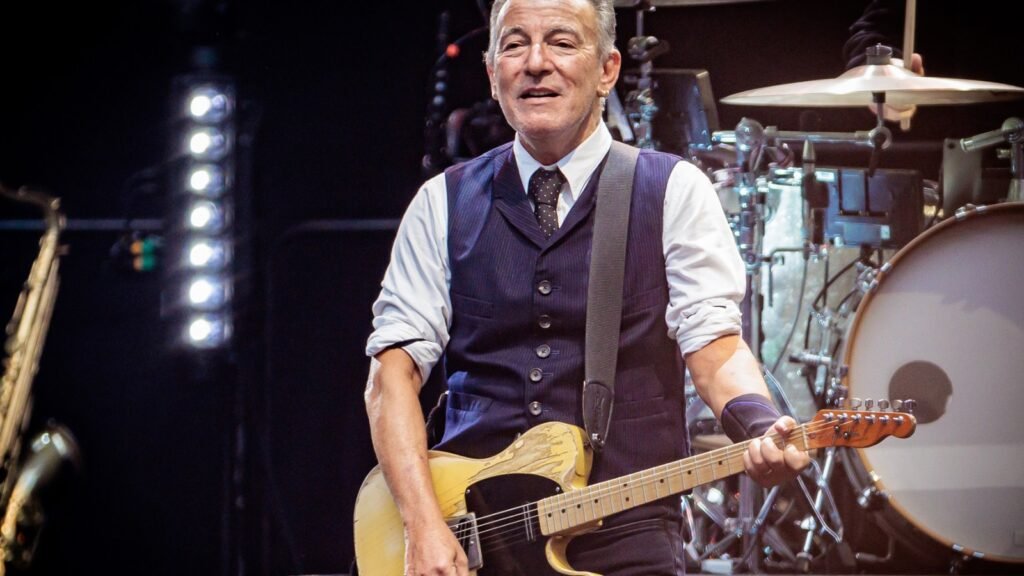
I met Santelli upstairs, in the larger floor that houses the Springsteen paraphernalia. There was a high school notebook in which he proposed band names (almost all had the word “Buffalo”). The teeny black-leather jacket he wears on the cover of Born to Run. The rickety TEAC Tascam 144 Portastudio on which he self-recorded Nebraska. The Telecaster he toured with for years. The jeans from the cover of Born in the U.S.A., which a Levi’s employee who visited this week identified as 10 years old at the time he wore them in the photo shoot. The red hat in his back pocket, which was given to him by a friend, says REMBASS, the name of military system designed at a New Jersey army base for use in Vietnam.
Santelli, 74, his arms bulging out of his black T-shirt from years of surfing, understands my fears. “We’re not a museum. We’re an archive with exhibition space and a performance theater,” he says. He also is aware of the limits of memorabilia. “Millennials, they are less impressed that you got Bruce Springsteen’s boots. You have to contextualize that into an overall story.” He has borrowed items from Hard Rock while he develops that story himself, which will be boosted by Jann Wenner’s archives, which he just received, as well as another collection he soon hopes to secure. But Santelli believes that the music museum of the future is interactive, so he’s designing the exhibits that way. And while scrolling through a screen showing Springsteen’s drafts of his meticulous lyric changes is fascinating (he had “Well, they blew up the Chicken Man in Philly last night/They blew up his house, too” from the get-go), there’s also the danger that concert footage and interviews will feel no different than YouTube.
Springsteen, who has polished his legacy like those lyrics by writing a memoir and telling his biography in a Broadway show, wasn’t involved in the center, other than donating items — some of which he is reserving the right to take out from behind the glass and wear or play in concert. “He didn’t have any input. None. I had no idea if I was on the right track or not,” says Santelli, who panicked when Springsteen finally came to see the center a few weeks before it opened. “At some point, I should ask him, ‘Why did you let me do this?’”
I like to think that Springsteen didn’t get involved because he really believes it’s not going to be a museum about him. Sure, in the first few weeks, people like me will make the pilgrimage to see that Telecaster. But, as Kozlowski explains — oddly, since she was also pointing out Madonna’s bra and panties — the Center’s goal is to have its parking lot filled with school buses. “We’re preaching to the choir here when we have Bruce fans coming,” Santelli says. “ Bruce and I are most interested in talking to their grandkids and making sure that they have an opportunity to look at American history and culture through American music.”
It’s a museum made for high school me. One that would have inspired me to read Howard Zinn’s People’s History of the United States, which I saw among the collection of books from Springsteen’s home library, and is sold in the gift shop. To find out who Jackie Wilson and Benny Goodman were. To learn about Woody Guthrie’s protest music. To make me go home and listen to this Bruce Springsteen guy.
Touring Drummer on Her Triumph with Rush
When Rush‘s Geddy Lee first encountered Anika Nilles via YouTube, he immediately recognized...
Where to Watch the Steelers vs. Saints Paris Game Live for Free
Sunday’s game marks the NFL’s debut game in France, with the two teams facing...
10 Best Noise-Canceling Headphones of 2026: Top Tested, Reviewed Picks
If you purchase an independently reviewed product or service through a link on our website,...
Michael Gray, Star of ‘Shazam!,’ Dead at 75
The actor got his big break after landing the role of Billy Batson on the live-action show Michael...