Touring Drummer on Her Triumph with Rush
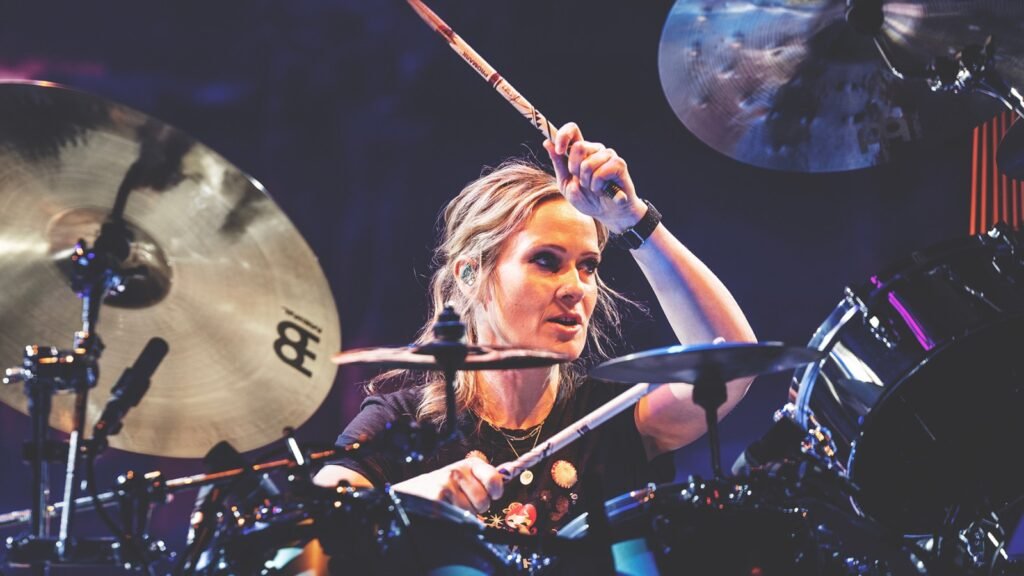
When Rush‘s Geddy Lee first encountered Anika Nilles via YouTube, he immediately recognized that she wasn’t just a singularly capable drummer who happened to specialize in odd time signatures, but also a star in her own right. “I was like, ‘Oh, my God, she’s so good,’” Lee told Rolling Stone. “She’s so interesting, and she’s got such charisma, personal charisma, and flair.” Nilles had little idea of the brutal amount of work that lay ahead when Lee and Alex Lifeson first asked her to come to a studio in Toronto last year and play some Rush songs — and she couldn’t imagine the worshipful reception she’d end up getting from the band’s fans.
The German-born Nilles, 43, was serious about drumming as a kid, but her parents insisted she pursue more practical work, so she studied social work and got a job at a preschool. When she was 26, she changed her mind, and went back to school to study music, fearing it was too late. Instead, her playing went viral, leading to a solo recording career, and eventually a tour with Jeff Beck, where Lee’s bass tech, John “Skully” McIntosh, first encountered her.
Neil Peart, who died in 2020, is “irreplaceable,” as Lee put it, but Nilles still had to try. As she learned 40 dauntingly complex Rush classics over a long year of rehearsals, she absorbed the essence of Peart’s style and feel, changing some of the basics of her own approach to accommodate it. In a newly released video interview for our cover story on Rush’s tour, published in collaboration with Rolling Stone Canada, Nilles sat down right after the tour’s first four shows in Los Angeles and explained exactly what it took to get there. (Watch the whole interview on YouTube or above.)
After four long nights that are just the beginning of a very lengthy world tour, how are you feeling in general?
I feel really good after these four shows. Really energized in a way, and relieved in a way. Yeah. Couldn’t be better.
It really became evident that the crowds appreciated you, were grateful for you, and also were rooting for you. Was there a moment when that became apparent to you?
Yeah, maybe in the third show. The first two shows I tried really to be focused on the music and on Geddy and Alex, and not to let everything else get into my mind too much. After the second show I could loosen up a little bit more and feel the audience and the vibe.
When you made it through all of the drum fills on “Tom Sawyer” every night, you would break into a smile. What was in that smile?
I made it! Yeah. I made it through it, the most iconic drum fill. And then I saw Alex in front of me smiling, so it was just such a good feeling.
What Ged and Alex have said was that as far as they’re concerned, getting the fills right was almost the easy part for you. It’s about getting the feel of the song right. And that’s true for you as well?
It is totally true, and especially on “Tom Sawyer.” That song requires a really specific feel to feel right also to Alex and Geddy. What happens playing-wise is doable. You have to get it into your DNA. But the feeling of all of those parts is really special, and it’s also hard because I had to let go some of my technique, which I usually use when I play those sneaky 16th notes. And to make the feel right and the sound right, I had to let go of that. I have to play more out of muscle power and less of technique to make that sit right. And that’s a last song in the set on most of those nights! And so I was really like, “OK, let’s do that. Let’s focus.”
Why does technique not work?
Because the technique I’m using is coming from my wrist, and it creates two sounds. And for that song, you just need that one specific sound. And so you play more out of your forearm and less out of your wrist. I had to learn how to create that sound, and it’s definitely coming more out of a strong accent stroke all the time. So yeah, that’s a hard one to play.
It’s about creating that almost robotic hi-hat feel. That’s what you’re talking about?
More like that straightforward, yeah, non-dynamic hi-hat sound, which is the driving force of that song, plus that little sneaky backbeat which always sits a little bit up front, all these little details, they have to fall in place perfectly to make that song sound and feel right.
You’ve said that there’s some Neil in your style now. You’ve absorbed so much. And Geddy was saying that there’s a sacrifice on your part, which is that you have to put aside some of your own style and try to inhabit or be inhabited by the spirit of this other drummer. What is that like almost on a spiritual level as a musician?
I love to be challenged. So for me, it was just like I wanted to make it right. I was up to let go of what I have studied for so many years to improve my own style and my own character on the drums to make them feel good and feel at home in their own music. And when that means I have to let go of certain things which I trained on for many years to be perfect in that, but it doesn’t fit to the music, then that’s the task. So I do that. And by that I learned so many things [for] my own playing at the same time, which I can in the end, after this, I can put everything together. I think that makes me an even better musician in the end.
What are some of the things you learned about Neil’s style?
It’s a lot. And what I learned for myself the most is the compositional part. He was brilliant in that, really. He constantly built and built the drum part to a point where you think, “What the hell is going on?” And he did that in detail along with the vocals. I think a big part of it is because he wrote the lyrics, so he was focused on lyrical parts and put that together with his drumming, and also melodically. So that was all lining up with the lyrics and the vocals. And that makes the whole composition so unique, and this is why you cannot just do your thing on it. You have to appreciate that and understand it as a musical composition in total. And I already feel when I play different stuff sometimes to warm up, so I feel like, “OK, this is a nice build up. Ah, OK. And not too much here. Let space to build it up more.” So it’s already in my system to create and build in a similar way, just from learning, studying the Rush catalog.
But there are places where you’ve figured out, I think, where you can add some of yourself.
Yes, of course. And this is the thing because I think I have no ego, so I play what is required. But at the same time, I’m a musician myself, with [my] own character and own style, and it sneaks in even if I don’t want to. And on some points I can really let go and just know that there is freedom to do it. And on some other parts I’m trying to replicate, but still my style sneaks in somehow. And then there are parts where Neil’s style and my style line up perfectly, where I feel it the same way like he did. I don’t have to think about parts like that. It’s just coming out in a very similar way as he played it, and it’s just this kind of thing going on through the whole set.
I think there’s moments when you’re actually making parts more complicated, which might be the opposite of what someone would assume. You’re adding flourishes, which is interesting.
Yeah, maybe there my fusion-esque style sneaks in sometimes. Yeah. But that’s my personal fun with it, and as long as Geddy and Alex are fine with it and they seem to have fun too, then it’s fine. It’s just [in] small spots.
You’ve become a Rush fan while you’re playing with Rush. And I think I can see you just enjoying the music up there.
I do! And [a] couple of times I thought, “Why didn’t I learn and listen way earlier in my life to Rush?” Because I love it. The music is great. It’s so much fun to play. As soon you don’t have to think about parts anymore and can loosen up a little bit, it’s just so much fun to play with those guys. They have so much energy, and they enjoy playing. And yeah, it’s like a whole vibe going on. Yeah, so much fun.
How would you describe your vague idea of Neil as a player and Rush as a band before you got this call?
For me, Neil was always a very energetic, powerful player. What I saw online, basically. I never saw the guys live before. But he was always very focused, very energetic and powerful, and that’s a thing I really like. I love powerful drums, powerful playing. And I basically knew him from “Tom Sawyer” performances, “Limelight.” But I never really studied the music or his playing in a way. I never really studied a player before in detail. I just got inspired and enjoyed watching other drummers play in a style I really like, and that was the case with him for sure.
And Rush you kind of just knew as a complicated band that musicians liked?
I just knew Rush through Neil. As I said, I never really got deeper in their catalog before. So I saw Neil playing in this drum universe I was in, and saw his performances with the [jazz] big band and stuff. But Rush was Neil for me in a way, and I grew up with other bands [that] came after Rush, like Dream Theater and Foo Fighters. When I was a teenager, that was the go-to music for me, which was obviously inspired by Rush.
Was there some kind of technique that you had to adopt in order to just absorb all this musical information? If you were a classical musician, you’d be reading from charts, but these guys somehow do it all from their heads, and you had to get there too.
Yeah. Yeah, I learned really quick that charting out stuff doesn’t work. Like what Geddy said, some of the things they play are more [about] feeling, like timing and phrasing. So you technically can write it out, but then you read it that way which is it written, and it’s not how it sounds in the end. So I let go of that immediately, and I even let go of the counting part [sometimes] because the music itself is written in a way so that it feels natural. Even the odd stuff does not feel odd. It feels straightforward.
As they sent me songs, I would listen to it really quick and make a decision which song I started first. And then I thought, “That’s one I can do quick. That’s an easy one.” Then I started really working on it, it’s like, easy? Nothing is easy here! So it was really like, OK, I have to make chunks for myself, learn it step by step, but I didn’t count anymore at some point, which was a big thing for me before. I always wanted to understand — what time signature is it in, and all the little details of how is the groove built, and what’s happening on this 16th note. I didn’t do that with that catalog. I just learned it in a way [where] I listened to the drums as a melody. Melodic phrases. That’s what sticks in my mind. Everything I play is a melody in my mind.
Neil told me there was an element of three-dimensional geometry in the way that he crafted his parts, that they were almost these constructs in the air.
Yeah. I feel this is the way he wrote the parts, because they are melodic. I say always it’s a rhythmical melody. And that’s the way I approach a lot of my drumming in general. So I just jumped even more in this direction to learn the songs, to understand the whole drum composition as a melodic structure, and that definitely helped to go way quicker through everything.
Carrie and Olivia, Neil’s widow and his daughter, were at the first two shows. Did they want to meet you?
I got a nice message from [Carrie]. Really lovely message. Before the show, actually. Yeah, that was really nice to hear that she is on board and looking forward to this whole journey and how it turns out. This was really nice and lovely.
It doesn’t seem like you had ambitions this big for your career. This is beyond, I think, anything you imagined.
It is totally beyond what I’ve imagined at all. My journey is a bit different — I started off being a professional as I was 26. And it was a huge turn in my life, and I never thought that something big like this would really ever happen. I would have been happy with a regular touring gig in Germany. While studying music at university, it started off with all these YouTube clips with the original stuff, and it turned out in a different direction than I imagined.
You were teaching at a preschool right before you went back to school for drumming.
Yeah, it’s true. Yeah.
And if you went back and told yourself that all this had happened, would you have believed it?
No way. No way! This is not an everyday gig, yeah. This is special.
Your dad is a drummer. How do your parents feel about all this?
They are over the moon. They are super-happy. They were always super-supportive, I have to say. But they wanted to have me in a more safe environment financially, [so] I had to do this social-education study before. But they always were supportive. They drove me everywhere to rehearsals, to every gig, before I could drive myself. So they’re pretty much awesome parents.
As a touring drummer you’re replacing this guy who is either the greatest rock drummer of all time, or certainly one of the greatest rock drummers of all time. That’s the core of what you’re doing. To what extent did you just avoid thinking about that?
I think starting rehearsing the songs almost a year before [the] tour start definitely helped to settle into this environment together with the guys, learning the songs. I just was so focused on the music and getting everything together. So in a way, Neil was always there. It was a big thing for me to learn all his parts and learn about him. But at the same time… I created my own environment to sit in, and that helped me not to think too much about what others will think about it. I didn’t let fans or comments or social media too much into my brain, and tried to stay focused. I tried to do that until one day before the show. I was really strict for myself in that. And calming routines. Zen time before the show. I did 45 minutes meditation before the show just to calm myself, just to be present here. And in each song part, I had to coach myself a little bit through it, especially in the first show, not to fly away, be focused. And that all helped not to think too much about how big that seat is and what role I’m filling in at the point where I’m sitting onstage. Be in the moment, be present, be focused. That was my goal for all the shows so far.
Before this gig, you mentioned you felt that you had to compensate with technique because you said you can’t hit as hard as male drummers. But when you hit the snare, it seems to me you’re hitting incredibly hard. So I don’t know what to make of that.
I hit the gym! Especially for this gig, I hit the gym very hard to make sure that I have the stamina and the power. And I had to let go a little bit of my technique, so I had to compensate with more muscle power on some point just for the playing part of it to make the feel right on some songs and parts. Yeah, that maybe increased the power in playing.
You’ve gotten stronger!
Yeah.
Classic rock has been a very male thing.
It is.
And you’ve broken the general boys’ club of classic rock. It must feel good.
For sure. I hope that opens the door for some female musicians in general, or especially drummers, to just be brave and not give up on the road to whatever the goal is, yeah, for sure that’s a thing I hope for.
Where to Watch the Steelers vs. Saints Paris Game Live for Free
Sunday’s game marks the NFL’s debut game in France, with the two teams facing...
10 Best Noise-Canceling Headphones of 2026: Top Tested, Reviewed Picks
If you purchase an independently reviewed product or service through a link on our website,...
Michael Gray, Star of ‘Shazam!,’ Dead at 75
The actor got his big break after landing the role of Billy Batson on the live-action show Michael...
Where to Buy Garth Brooks Tickets: Prices, Dates
If you purchase an independently reviewed product or service through a link on our website,...