Meet the Yes Keyboardist Who Also Gave Us Asia’s ‘Heat of the Moment’
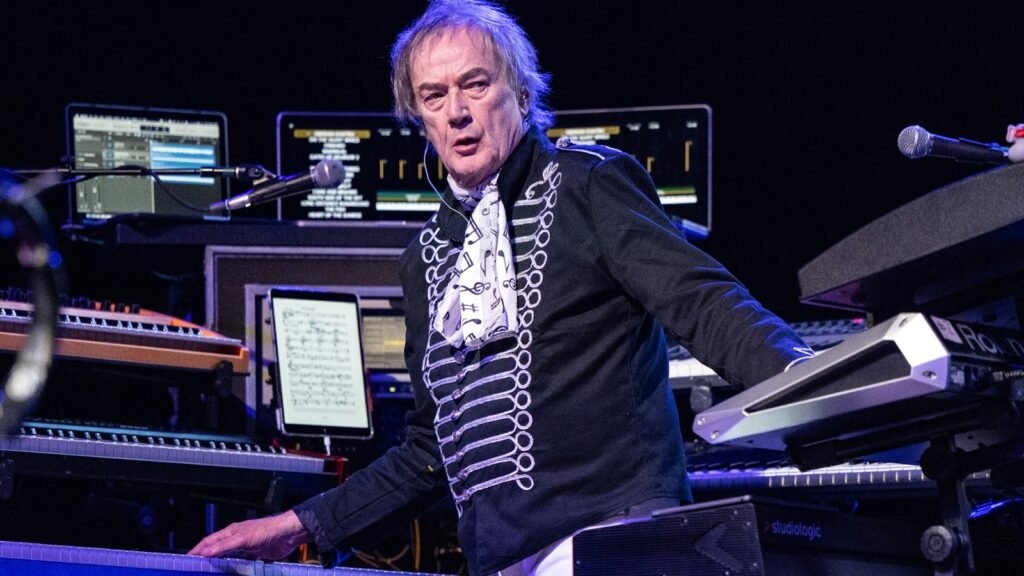
Had things turned a little differently for Geoff Downes, the keyboardist would have gone down in history as merely the guy whose opening notes to the Buggles’ “Video Killed the Radio Star” kickstarted MTV, and an entire new era of music history, when the cable network launched on Aug. 1, 1981. But that song was just step one on a journey that brought Downes into the prog-rock supergroup Asia in 1982, where he co-wrote the immortal classic “Heat of the Moment,” and into Yes, where he’s served as their keyboardist since 2011. (He was also also in Yes for several months in 1980, after recording “Video Killed the Radio Star,” but before MTV played it. It’s all somewhat complicated.)
Downes now holds the record for the longest continuous run as a keyboardist in the six-decade history of Yes. “Who would’ve thought that?” Downes asked us via Zoom from his home in England. “When I was listening to Yes when I was a student at music college, I never thought that would be the one thing somebody would be saying to me today.”
Shortly after graduating from music college in 1976, Downes responded to an ad in Melody Maker that read, “Chart act wants keyboard players.” It turned out the ad was placed by a musician named Trevor Horn, who was putting a band together to accompany disco singer Tina Charles on a tour. “He gave me the job out of about 40 other keyboard players,” says Downes. “And he later told me, ‘The only reason I gave you the job was because you turned up with a Moog synthesizer, and none of the other guys did.’”
When the Tina Charles tour ended, Horn and Downes formed the Buggles. One of the first songs they wrote, working with guitarist Bruce Woolley, was “Video Killed the Radio Star.” It was the start of a very long career, and today he balances his time between Yes and a reconstituted version of Asia. He walked us through the entire saga, and looked ahead to the new Yes album, Aurora.
Tell me the origin of “Video Killed the Radio Star.”
The lyrics are inspired by Trevor. Trevor was very great at lyrics, and he read a lot of science fiction books like those by J. G. Ballard and quite a few others. And he got the idea that there were these kids in the recording studio that were soaking up sound with a vacuum cleaner, and it was all crazy stuff like that. And that’s why it was very much about how technology was changing everything, not just music, but in the same way that in films, when the talkies came in and the silent movie stars were put aside because the talkies were the big thing.
One of the ideas behind it was that technology in art forms can supersede previous versions in the same way that, I suppose, digital music has superseded cassettes and CDs to some degree. We were very much into the technology, and that was one of the things that really drove us along.
There’s a lyric in the song which is probably even more relevant today with AI, which is, “It took the credit for your second symphony/ Rewritten by machine on new technology.” So it was a very forward-thinking song when you think about it. That song is nearly 50 years old, but I think we were very much ahead of the game in our thought process.
It must have been fairly jarring when you two joined Yes right after for the Drama album and tour. It’s a very different sort of gig.
Trevor was very much the producer in a way, and I was very much a keyboard player. As a vocalist, he was more used to singing through effects and that kind of thing. So when it came to actually doing Yes, it was very much a case of Trevor being pushed to the front. And it was a difficult role when you think about how Jon Anderson had been the lead vocalist from the very beginning. For Trevor in particular, it was hard. And it wasn’t so hard for me in a way because Yes had three keyboard players prior to me. So they were a little bit more lenient on me. But I mean, I think that it was an outrageous concept for a lot of the Yes fans to think that these two pop guys suddenly emerged in their revered, spiritual band.
I can’t think of another time in rock history when a complete band was just absorbed into a bigger one.
From my standpoint, it was a great career move because I think both Trevor and I felt that the pop world was a very uncompromising world, and had a very cruel rejection factor because you were only ever as good as your last hit. When we had the opportunity to join Yes, they weren’t about having hits. They were about making these albums, and taking it to the big stage. So that’s why we relished the challenge. And Chris [Squire], and Steve [Howe], and Alan [White], they were a little bit at a loose end because Jon [Anderson] and Rick [Wakeman] had left, so for us, it was a much more natural thing than it looked from the outside, I think, with me being a keyboard player and Trevor being a vocalist.
I love Drama, but there wasn’t a huge appetite for it in the aftermath of punk and new wave.
Yeah. Well, funnily enough, I think that as much as the die-hard Yes fans were outraged at the time, I think that they have warmed to the album over the years because they see it as a milestone, a stepping stone for a band like Yes to go from the ’70s into the ’80s. And I think that that was a turning point album for the other guys because instead of these very spiritual, rustic lyrics and “just by a river” and all the rest of it.
Trevor’s influence was talking about technology, and his lyrics had a much more modern slant. And that was one of the reasons why I think Yes has been as successful as it has over the years. It’s not a band that stood still. And I know Trevor produced the 90125 album, but I think that we actually paved the way for that album with Drama because I think that it opened the doors for Yes to move into another generation. Yes has continued to do that over the years.
The Drama tour started in Toronto at Maple Leaf Gardens. What was it like for you and Trevor to walk onstage and face that crowd? Many of them didn’t even know that you guys would be there.
They thought Rick Wakeman and Jon Anderson were going to be there. For me, it was a real baptism by fire because I’d never played a venue that size before. Well, I’d done a few dates in Canada before with a disco singer, but I never actually played to an audience like that, and it was just mind-blowing.
I think that’s what gave me the taste to do that for the rest of my career because that opening night was just such a thrill, and to be out there with those great musicians onstage and getting all the support from the audience, which we did, was great. And even four nights after that, we were doing a three-night stint at Madison Square Garden. So when you think about that first couple of weeks that we were in the band, it was just crazy times.
It was one thing for you to be the keyboardist, but Trevor had to stand in front of that stage and hit those high notes, sing “Roundabout,” face those fans. I can’t imagine the stress on him.
I mean, he did incredibly well to be able to pull that off because it was not really his exact role. I mean, as I said before, with the Buggles, we’d always use devices on vocals and things like that because we were big tech heads. Anything we could try to make something sound different, we would.
But when it came to Yes, you really had to try and deliver it in a way that those original songs were written, that Jon Anderson so brilliantly wrote. But I think Trev did a great job, and I think that the fact that we had the Drama album behind us, people started to appreciate the work that’d gone into it and what it sounded like. And I think some people got it, some people didn’t. But over the years it’s been widely appreciated by a lot of the Yes fan base.
Back to the Buggles — tell me about the “Video Killed the Radio Star” video.
My claim to fame is that I played the opening chords on MTV, which is the keyboard intro of “Video,” and also the very last video on MTV, funnily enough, when it finished [in England] just before Christmas, and they went out with that.
It was weird because it was done in a day. The director, a guy called Russell Mulcahy — Australian guy — he went on to do the Highlander films and things like that, but he was just a jobbing video director, experimenting a lot with technology at the time. And a lot of it was just shot on straight video cameras. It wasn’t filmed or anything like that.
He had the vision of how to put it together. Some of it reflects the lyrics, the abandoned studio, you see Trevor and myself. And, of course, my keyboard programmer’s not done too badly for himself, Hans Zimmer. He had a cameo appearance at the very end because Hans was programming some synths for me.
Do you remember first hearing about this new thing called MTV?
Well, that’s interesting because it was weird. “Video Killed the Radio Star” came out in late 1979 and, of course, hits went up and they went down, and that was it. You didn’t really hear much more about them at that time. Someone called me up around probably August or September 1981, after MTV had aired, which was two years after “Video Killed the Radio Star” had been released.
They said, “They’re just starting this cable network mainly on the East Coast, and they used your video.” I said, “Quite nice.” But I didn’t really think much more about it because at that time MTV was in a very formative period. But as the weeks went on and it started to network right across America, it became the go-to thing. So in a way, the prophecy of video taking over from radio was starting to gain some momentum.
One could argue the entire decade of the 1980s began with your keyboard intro to that song when MTV launched. It changed everything.
I think it did. And I’m grateful that I made a contribution, but by the time MTV had been on for two or three months, it was everywhere. And then I think the record labels started to see the value of having that out there because it had such a wide audience, particularly with young people. It started to get a bit out of control because they would throw hundreds of thousands of dollars into making these videos, trying to get a leg up over each other. It was the most perfect shop window for selling records because it was a visual that was going to capture that generation of young people.
I know that you started making that second Buggles record with Trevor in 1981, Adventures in Modern Recording, before you joined Asia. What happened there?
When we finished with Yes, which was the end of 1980, I started working with Trevor on the next album. Again, it was a very, very experimental album. I think that there was quite a lot of influence that we’d got from our time in Yes. And certainly, we started to really work on longer songs, which was not particularly in favor with the record label because they just wanted more “Video Killed the Radio Star, Mach 2.”
It coincided with the fact that Steve had been working with John Wetton on some stuff, and Geffen Records were looking at trying to put together this band. They’d approached John before. And then I got a call from Steve. He said, “Look, I’d like you to meet John because we’re putting this band together, and we think you might be the perfect fit for the keyboards.”
So that was really a continuation of the relationship that I had built up with Steve in that short period that I was in Yes. And then Carl [Palmer] came in. So that’s really when I said to Trevor, I said, “Look, I’ve had this opportunity to join this band that is looking like it’s a big band, or certainly has some big names in it.”
I was the smallest name because obviously John, Steve, and Carl had this huge history in the ’70s behind them, which I didn’t have. That was really the turning point. We got about halfway through the [Buggles] album, and I said, “Trevor, look, I’ve got to go,” and that’s it. But it’s still available, and half the tracks that I did with Trevor are actually on it.
Tell me about writing “Heat of the Moment” with John Wetton.
It was written right at the end of the Asia album. John Kalodner, who was the head of A&R at Geffen Records at the time, he loved the stuff we’d done, and he loved the album. He said, “You guys, if you had one more in you, just one more song, a lead-off track, this album’s going to be huge.”
So I sat down with John one afternoon. We sat at a piano, and I said, “Look, we’ve got this brief from Kalodner. What are we going to do?” And John said, “I’ve got this little tune here. It’s like a country song.” And he played a bit of the “Heat of the Moment” chorus. I said, “I’ve got this little verse part.” And he said, “That’s good.”
So we literally just put the two things together. We had the intro, but it was quite a lot of work to get Steve to play power guitar because it’s not his natural, go-to sound. So we put together the middle eight, which didn’t take long. It all just came together very quickly, and in the end, we went in and recorded it as the last thing on the album. Kalodner said, “That’s it. That’s the one. That’s the one we’re going with.” And then we got all excited, and all the label guys at Geffen Records were really excited about it. And then, of course, it came out and, bang, it just flew all the way.
What was it like turning on the radio for all those months and just hearing your song everywhere?
When we were out promoting the album just before we went out on tour, I remember it really started to get played on every radio station in America, particularly rock radio. I remember John and I were sitting in the back of a car, and it came on the radio. I said, “Wow, that’s fantastic. So see if there’s anything else on,” and we flipped to another station, and it was playing on that one as well. And I think when you get to that point, you realize that you’re onto something pretty big. I still get a buzz when I hear it on the radio. It’s part of my DNA, I suppose.
When many young people hear it today, they think of South Park.
Or The 40-Year-Old Virgin. I mean, it’s an evergreen song. I’ve got two pretty big songs that I suppose I’ve been associated with, “Video” and “Heat of the Moment.” They continue to get played a lot. I mean, less obviously, songs off that first Asia album, like “Time Will Tell,” “Don’t Cry,” and “Sole Survivor,” still get played. That first Asia album just went through the ceiling. I think that it was nine weeks at Number One.
I’m sure it posed some difficulties though. When you go to make the next record, the spotlight on you is blinding, the label wants more of that. And how do you top one of the biggest albums of the year? You can’t.
Well, in a way, it was the same principle because they just want more. The record labels are very greedy. If they think they’re onto the golden goose, they want it to lay more and more eggs. And I think that we were pretty exhausted by the time we’d finished that first bout of touring because we spent six months rehearsing the first album, we spent the next five or six months recording it, and then we went straight on the road for another six months, so we didn’t really have much time to sit down and take a relaxed view of it. It was very, very intense.
By the time we’d finished that, they were pushing us to do another album, saying, “Come on, come on, we’d like to get more of this.” And it does put a lot of pressure on you because you suddenly realize that, “Well, are we good enough to come up with something as good as that first album? Is the direction going to be right?” With all of those things, you do question yourself.
Under the circumstances, I think that John and I came up with some really good songs for that second album. And it wasn’t a flop. I mean, it still sold nearly three million copies, but because the first album had sold six or seven million worldwide, the record label saw it as not a disaster. But had we started off with three million and then moved to a second album that sold seven million, they would have been ecstatic. But because our first album was so big, it was very difficult to emulate that. Not that we wanted to emulate it because I didn’t anticipate it was going to be that big at all. I thought, “Well, it’s going to get some traction,” but eventually it sold in excess of 12 million albums worldwide. You have no formula that tells you that’s what you could do because you just make the music and hope for the best.
Right. And then the lineups kept shifting. Did it get difficult when Greg Lake was there for a minute, and then Steve leaves before Astra? That must have really made it tricky to get momentum.
Yeah. I think that you definitely lose momentum when that sort of thing happened. And I think because of the pressures that we were all under … and some people take on pressure differently from others. But I never fell out with the guys. I don’t think anyone really fell out with each other. I think it puts people in a different space, and they’ve got different influences from wives, managers, accountants, and agents, and all the rest of it. But having said all of that, I think that second album was a good album, and I think that on the third album without Steve, when Mandy Meyer came in, we were still a good band, and I think that we made a good sound.
You made a lot of Asia music with John Payne in the ’90s. Was that a sort of frustrating period because the industry had changed so much, and that kind of music just wasn’t getting on the radio or MTV?
That was a difficult period. And again, the albums were good albums, I thought. And in hindsight, I think that a lot of people look back on those albums and appreciate them for what they are, but the climate had changed then. There was much more emphasis on guitar-oriented bands, particularly in the ’90s, a lot of the big hair bands and the heavy bands, like Poison and W.A.S.P.
So that whole movement really was hard to compete with for us because I still wanted to maintain the essence of the Asia music, which, as you probably would agree, is very, very keyboard-driven. So yeah, it was a hard time to try and get things through. I think John did really well with his vocals. I think that he was a different kind of singer from John Wetton, obviously, but again, the harder edge we’d hoped for might add a little bit more interest from people. But we had a good time making those albums, and I think that a lot of people got pleasure from listening to them.
How did the 2006 reunion come about where the full original band reformed?
I’d been in touch with John for quite some time on and off throughout the years, and I was working on some solo albums with him, and we had our own project called Icon as well. So I was working with John on that front, not so much with Steve because Steve was off doing a lot of the Yes things, the 35th anniversary and all that stuff. Carl was very much doing the ELP stuff as well. So it was really an idea that came up and said, “Look, what do you guys think?”
Steve had a good window, Carl had a good window, John and I had good windows, and we said, “Why don’t we give it a shot?” It was actually only going to be a tour or a couple of tours just to test the water, really. We started to get a lot of interest, and we had some great offers to tour in Japan. So this all gained a lot of momentum. We played Mexico, we played South America, we’ve been pretty well everywhere.
Then you recorded Phoenix in 2008.
Yeah. We sat down and said, “Why don’t we make an album?” And so that’s how the Phoenix album came about. And the momentum continued from there. There was still a lot of interest in the band, so we toured pretty extensively then.
We were fitting it in around Steve, who was still going with Yes at the time, and Carl started to do his three-piece ELP legacy project. John and I had our own project, the Icon project. So we were all involved in doing other things, but we managed to pave the way to put the Asia thing together and continue it. And then we went out, we did the second album, did a third album. That ran really until 2012. Steve, at that point, turned around and said, “It’s just going to be too much for me,” because he had his trio going as well, Yes going, and also trying to keep his solo stuff going. He felt that it was too much to do. So Steve left in 2012.
Around this time, John Payne was touring as Asia Featuring John Payne. That must have been irritating.
Yeah, it was a bit awkward because I think that we considered ourselves… well, we were the original band, and to have all four of us back together again was quite something. It wasn’t really too much of a problem. But because John had been in the band for that period, he had some right to the name. But he agreed to call himself Asia Featuring John Payne, which we agreed to, and that was it. But obviously we had the Roger Dean logo, we had the weight behind us.
How did you wind up rejoining Yes in 2011?
Trevor had been asked to produce an album for them in 2011, and the material that Chris wanted to do was actually a song called “We Can Fly From Here,” which we performed on the 1980 tours. In fact, we did a recording of it for the Drama album, but it never saw the light of day. And Chris was really adamant that they should resurrect this song and make the album around it. Because I was co-writer of that, and because I was involved in the original recording, the guys felt that it would be good to get me involved again, and so they got me to come down to the session.
It wasn’t really a case of them being dissatisfied with Oliver [Wakeman] or anything like that. I think it was much more that they felt that I’d been much more appropriate for this particular album and this concept that they were doing, and so that was really the reason why I went back in there.
It was great to be back in the room with the guys again. Chris, Alan, and Steve were playing like crazy, and what I reckon was probably the best rhythm section ever, which was Chris Squire and Alan White. It was really, really great. And, of course, Trevor was there as well producing, so it was a great moment for me to actually turn the clock back and be in the studio with all of them, the Drama lineup.
Your first tour back in the band was a co-headlining run with Styx in 2011. I spoke with Benoît David a few years ago. He said it was a nightmarish time for him because his voice was blowing out.
Yeah, it was very unfortunate for Benoît because I think that he was probably being forced to sing in a register that was not natural for him. And so I think he caused himself quite a lot of damage vocally by pushing it. I think also the fact that Yes were a very loud band onstage… Chris Squire’s bass rig, they used to call it “the rig from doom” because it was basically just a huge, massive amount of speakers.
I think that probably that didn’t really help Benoît because he tried to sing above all that. By the end of that tour, I think we were in Stockholm, and he turned around, and we had about three more shows to go, and he said, “I can’t do this. I can’t sing it.”
Jon Davison blows me away. He seems built for this. No matter how many shows you guys do, his voice just holds out. He hits those high notes every night.
It’s incredible. Jon has a fantastic voice, a fantastic range. I have him quite loud in my in-ear monitors because I like to hear the melody, and he’s absolutely impeccable. I’ve never heard him sing out of tune or anything.
Yes very much is part of his heritage. He was in Yes tribute bands, and he knows the Yes music probably better than anybody else, better than the members of Yes. He knows all the obscure songs and everything like that. He really was extremely diligent. We were very, very lucky to get him to take over almost straight away.
I spoke to him a few months ago. He told me that Heaven & Earth was a very difficult album to make since Roy Thomas Baker wasn’t really providing leadership.
Yeah, I think it was difficult for him because he just literally walked straight into it. There’s some not-bad moments on there, but I don’t think it would ever go down as a Yes classic because I think that no one was really that focused on it in musical terms. I think it was just something that we felt we’d put together.
I don’t think Roy Thomas Baker, bless him, was the best producer to be involved with. I think it was more a case of using the name rather than finding the appropriate type of producer we would have needed because he was not really that selective with the songs. It was not really a great way to work on an album, but having said that, there’s some okay stuff on there. It’s a period piece, it’s part of Yes history, and so you can’t really ever eradicate that.
Did it bother you when Yes were inducted into the Hall of Fame, and they didn’t include you?
Not really. I think they had a band, I don’t know whether it was Parliament-Funkadelic or someone like that, where they had tried to induct 35 members or something like that. I think that’s when they put their foot down and said, “Look, we can only really accommodate” … what they would consider to be the two golden eras of the band, which would be obviously the ’70s classic lineup and also the biggest-selling Yes album by a long way is 90125, so they had to acknowledge that lineup as well. But I think it was nice that Tony Kaye got in, and I think it was probably about right in the end.
Losing both Alan and Chris must have been agonizing.
They were both really tough moments. Chris was always pushing me. He was almost a mentor, so that was a very tough break because he was the driving force behind the band. And Alan had become a very great friend of mine, and we always hung out together. We were very close with each other. But we had some great times together, and I have very fond memories of working with both of them.
Steve impresses me every time I see you guys. The dexterity in his fingers is just incredible when you consider his age. He’s basically playing just like he did 50 years ago.
Steve is approaching 80. I mean, he’s incredible. I’m just grateful that I’ve had such a long-spanning relationship with him because it’s always tricky having a keyboard player and a guitarist because there are areas where they can get in the way of each other. I think that one of the things that Steve and I have managed to ascertain, not just in Yes, but in Asia as well, is that there’s a kind of understanding. Steve’s very much a fluid, very individual solo-type player, much more than a rhythm player. And I think my style of keyboard playing does complement Steve’s guitar playing.
The Buggles toured with Seal a few years back. Why weren’t you a part of that? Were you busy with Yes?
It was an idea, but it clashed with some of the Yes tours. And I think that it was not something that … I think it was more to do with the fact that it was Seal’s backing band. And then, of course, Trevor had a long relationship with Seal as his producer. I think it was more of a Seal show than a Buggles show. Had I not been tied up with the Yes thing so closely, I think I probably would’ve done it, but I think they were only playing sort of five or six songs a night. So I like to put myself out a bit more and do three hours of “Close to the Edge” and “Going for the One” and all the rest of it.
Do you hope that one day you and Trevor will do more Buggles shows?
I’m sure we will. I speak to him every few months, and we always get along. I can happily say that out of all the people I’ve worked with, particularly in the three bands that I’m most known for, I’ve never really had a bad fallout with anybody. I could still pick up the phone and speak to people today. Sadly not Chris, John, and Alan, but certainly all the other guys.
You’ve kept Asia alive in the aftermath of John Wetton’s death. Can you tell me about bringing in Harry Whitley to sing? Where did you find him?
He’s incredible, and I don’t say that lightly. Coming across someone that is so young — I think he’s 30 or 31 years old — to have the kind of knowledge that he has musically is incredible. And not just as a bass guitarist. He’s a fantastic keyboard player. He can play drums. He’s like a modern-day Stevie Wonder in terms of being able to play just about anything.
It’s very rare to come across someone so talented. He was a huge Asia fan. He’s a big fan of my keyboard playing, which is very kind of him, but I think the main thing was that we did this tribute for John a few years ago, and I’d heard about this guy posting stuff on the internet. I thought, “Wow, this guy, he can deliver those Asia songs incredibly.”
And so when we had this tribute show for John, I invited him along. And the audience just went absolutely crazy. So that’s what really spurred me on to put the band back together again. And I know Carl is still very busy tied up with his ELP legacy stuff; that’s pretty much his full-time gig. So we’re quite happy to bring in Virgil [Donati]. And [guitarist] John Mitchell was involved with the Icon project and John’s solo stuff, so there was another good connection there.
It was great to actually be able to connect all these people again and then put together these shows, which have been really successful. We’ve been to Japan a couple of times. We did a whole U.S. tour the summer before last, some big gigs, some big dates. So it’s been very, very interesting to actually get it all going again.
Tell me about the new Yes album Aurora, and how Steve functions as a producer.
Well, I think it’s very much a case that songwriting has changed quite considerably. A lot of the ideas are sent through the internet rather than the days of a band thrashing it out in the room together. I think those days are pretty much over for a lot of people. File exchanging is probably the most common form of musical collaboration now. We embrace that.
That was really how we’ve exchanged ideas actually for all three albums that we’ve done in recent years. And more so, I think, with this album we tried to get a little bit more studio-friendly collaboration, which I think we actually did a bit more of this time, funnily enough. Billy would work with Steve and I’d go down and work with Steve, but Steve is very much the focal point of the album. I think that he knows Yes better than anybody else, so I think that it makes sense for him to have that middle role that everyone bounces off.
“Countermovement” is probably my favorite song on the record. Can you tell me about putting that whole suite together?
That’s very much a case of a song that literally is just so many ideas all thrown together. I think that it’s a great piece, and Steve’s guitar playing on that is just outrageous. It’s a very unusual piece. It makes me happy to think that we could actually come up with something like that. It’s very much everyone’s ideas being thrown into one great thing, and Steve somehow has managed to sift through it all and put together what I think is a very, very powerful piece. Whether or not we’ll do it live, I don’t know, because there’s a lot going on, so a lot to think about.
You guys played Fragile straight through on the last tour. Are you thinking of doing a different classic record on your next tour?
Steve had to have an operation this time, we had to postpone our U.K. tour, so he’s going to be out of action for a little while. But we are due to go to Japan in September, and we’ll be doing the Fragile tour there because we haven’t done it there yet. But I think we’re going into the States in October and November, and I think that will be a completely different tour.
Probably not an entire album, because I think that it becomes a bit predictable and we don’t want to be seen as a predictable band. We want to be able to pull different things out. But I certainly think that we’ll pull out some lesser-known tracks and obviously some of the new album, so it’ll be something that we’ve never done before.
If Steve ever retires, would Yes carry on or would that be the end of the band?
That’s a difficult one, really. I mean, I’m sure it will. I’m sure there’ll be some version of Yes going out there. I’d like to think that it would because I think that music’s timeless, isn’t it? And I think that the music of Yes doesn’t deserve to be put in a box. That’s what I feel about Asia. I don’t want to say, “Oh, that was Asia. I’m never going to hear that stuff live again.” I mean, I think that would be sad. And I think that certainly the music that I’ve made, I’d like it to continue to be performed and presented all over the world for as long as it can be.
Slayyyter Cancels Remaining European and U.K. Tour Dates
“Because of this, I am forced to cancel the remaining U.K./EU dates to avoid permanent...
Atlanta Rapper Shawty Dred Indicted in $42M Federal SNAP Fraud Sweep
Atlanta rapper Shawty Dred has been indicted by the United States Department of Justice...
Aaron Carter Estate Settles Walgreens Lawsuit Over Xanax Prescriptions
The singer’s family settled wrongful death claims against the company and another...
Singer Jack Avery Faces Off in Court With Ex Accused of Murder Plot
The TikTok influencer accused of trying to hire a hit man on the dark web to kill singer...