
Hank Schrader (Dean Norris) and Steven Gomez (Steven Michael Quezada) in ‘Breaking Bad’
Ursula Coyote/AMC
Over 13 years after Breaking Bad’s heart- pounding finale “Felina” drew in a record 10.3 million viewers, Dean Norris, who played DEA agent Hank Schrader, and White’s brother-in-law Hank Schrader, in the hit series, is telling the stories that happened when the cameras weren’t rolling, including a surprising group of actors and other celebrities he watched one big scene with.
In his new Breaking Bad oral history, Do What You’re Gonna Do, Norris catalogs the show’s entire run through first-person interviews and stories from members of the cast and crew — including Bryan Cranston, Bob Odenkirk, Aaron Paul, Krysten Ritter, Giancarlo Esposito, and the late RJ Mitte. (Spoilers ahead: It’s been 13 years, people. Move it or lose it!)
When Breaking Bad premiered in 2008, the gritty crime series about a cancer-ridden high school science teacher making crystal meth to pay his debts didn’t just captivate viewers. It became a cultural juggernaut. Throughout five seasons and 62 episodes, viewers watched as the Albuquerque everyman Walter White — played by Bryan Cranston — transformed into a bald, pork-pie-hat-wearing drug kingpin named Heisenburg. The series won 16 Emmy Awards during its run, including four Cranston wins for Outstanding Lead Actor in a Drama Series. Norris calls this book the “definitive” oral history of Breaking Bad, a side of the hit show and its leading stars that fans might never have heard before.
In one chapter, Norris describes watching his character’s jaw-dropping death in the series’ penultimate episode ““Ozymandias.” After filming the episode, Norris did not watch the entire thing until it aired — when he was invited to actress Kate Hudson’s Pacific Palisades home.
Hank Schrader (Dean Norris) and Steven Gomez (Steven Michael Quezada) in ‘Breaking Bad’
Ursula Coyote/AMC
“This was not the sort of event where I would have been welcomed a few years earlier, but now I was Hank Schrader, the dogged cop on Heisenberg’s heels,” Norris writes. “I was one of the leading players on television’s hottest show, and with that status came a steady stream of invitations to a world I had never known, nor even been particularly interested in visiting. But I must admit, it was pretty cool.”
According to Norris, it was a surreal experience to watch a group of people who had no idea what was coming see the episode. And the venue, a popular celeb’s house, also meant the inclusion of a few unexpected guests.
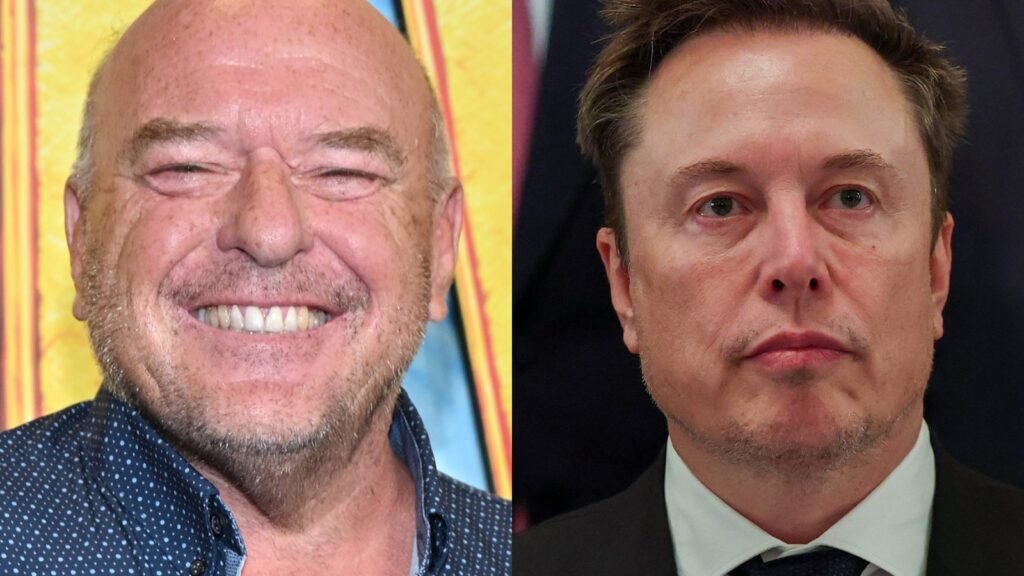
“When Hank took a bullet to the head, the whole room let out a collective gasp. Someone hit pause on the DVR remote, and everyone — Kate Hudson, Bruce Willis, Goldie Hawn and Kurt Russell, Elon Musk (!?), just to name a few — turned to stare at me,” he writes. “I almost felt like I was supposed to take a bow. Instead, I just smiled, as if to say, It’s okay. I’m all right.”
Elsewhere in the book, Norris talks about the kismet nature of how key cast members found their way to the show. When talking about Mitte — who died in October at age 34 — Norris reveals that Mitte was the last member of the White family cast. While the choice to have Walter White Jr. have cerebral palsy was made in order to make Cranston’s character seems more sympathetic to viewers, Norris notes that Mitte “crafted a fully formed portrait of an adolescent at the center of a family storm; one whose disability may have helped shape him but did not define who he was.”
When interviewed about his role, Mitte said he often channeled his own experiences with family and responsibility to make Walter White Jr. as strong of a character as possible — including spending five seasons building up to a final showdown standing up to his father.
“A lot of the decisions I made for Junior were based on my own experiences as a young adult. At the time I was still a child, but I utilized those moments from my own life of having to stand my ground and make that decision— realizing who I am and what I need to do to take care and provide for my family,” Mitte says in the book. “In the show, Walt was no longer doing that. He was actually creating more danger for his family. I think it’s very powerful that Walt Jr. had the ability to stand his ground, and to put those boundaries in place: “You’re out. This is my family now, and you’re not a part of it.”
Best Gifts for Holiday Parties & Family Gatherings From Best Buy
Hosting or heading home for the holidays? These four gifts will make the family gathering...
Noel Fielding Says He Regrets ‘Horrible’ Jokes He Made With Russell Brand
In his first statement since Russell Brand was sentenced to over 10 years in prison earlier...
Rosalia Wins Album of the Year at the Latin Grammys
Rosalía just made Latin Grammys history — again. The Spanish singer won the Album...
Scott Colom Wins Senate Seat in Mississippi
Of all the spectacular Democratic upsets in 2026 midterm elections — a statewide sweep...